






Features Of Car Racing In Rainy Conditions
 Story by:
Entertainment Blog
Story by:
Entertainment Blog
Bad weather is a serious challenge for every driver. Unpredictable weather conditions can radically change a team’s strategy and tactics, affect the control of the race car, and many other important aspects. Any high-speed circuit or rally race is always associated with high risk, but this is particularly evident in extreme weather conditions. To develop an effective plan and achieve the desired result, teams of drivers, including analysts, engineers, and other specialists, carefully study the external conditions. Nevertheless, the shifts are not always slow, and a reserve strategy of a team can enable them to adopt alternative strategies. It is impossible to foresee everything right, which is why careful and long-term preparation and modern forecasting technologies are necessary; however, the need to be prepared for any surprise should be noted. The same mentality is used in relationships.
It is possible to strategize the time of the date of your life, have your expectations straight, and study all the signals, but there is still something uncertain about human contact. Individuals change, feelings change, and timing has its contribution. Being adaptable, talking honestly, and maintaining your standards enables you to change without compromising. In dating, it is more about resilience rather than strict plans. It is not aimed at controlling all the results, but remaining on track and acting with reason when things go wrong. This article will consider the nature of racing in rain and various forms of rain, and also comment on the mythical achievements of Formula 1 drivers when it rains.
Characteristics Of Racing In Rainy Weather
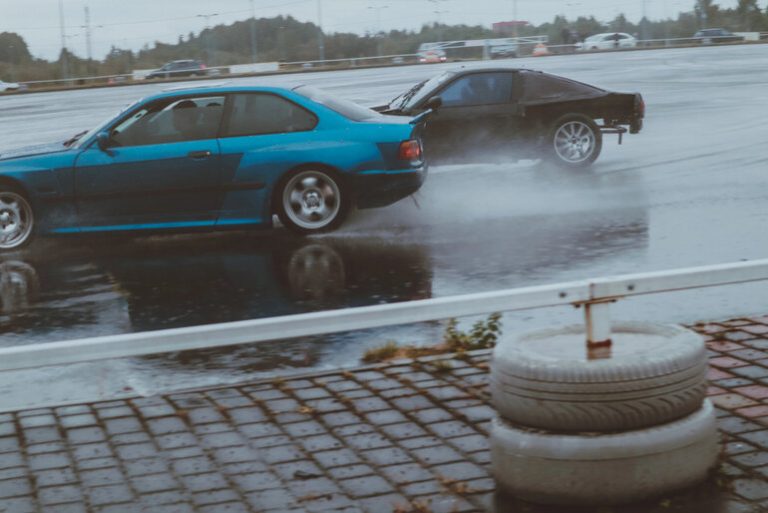
Rain always makes its own adjustments and can catch even the most experienced driver off guard. Even seasoned professionals know that racing in the rain demands sharper focus, lighter control, and respect for conditions that can change in seconds. In rainy races
- Visibility deteriorates.
- The grip of the tyres on the track surface decreases, making it more difficult to control the car.
- and the likelihood of dangerous skidding, drifting, and aquaplaning (the risk of complete and instant loss of control of the car) increases.
Communication between the driver and their team is crucial, as it is the team that can respond most quickly to emerging problems and resolve them promptly.
Tyre Replacement
The first thing to do when it starts raining is to replace the smooth tyres with intermediate or rain tyres (depending on the forecast). If we take Formula racing as an example, slicks without tread grooves are used in dry weather. On standard road ‘civilian’ tyres, they exist in great numbers to remove water from the so-called contact patch. This is the area of contact between the tyre and the road surface. The larger it is, the stronger the grip, the higher the stability, and the better the handling of the car. Stones, debris, water, and technical fluids, dirt, and even dust on the road impair these qualities. Ideal conditions: clean and smooth asphalt, smooth tyres with a compound that is best suited for grip at the ambient temperature. That is why drivers use slick tyres in dry weather.
The same is true of the relationship responding to the environment. Emotional baggage, unsettled past, conflicting purposes, and external interference may silently diminish the friction between two individuals. Even intense attraction fails when the surroundings of it are unstable. Having clear communication and emotional availability and being on the same page helps in building the right platform upon which to proceed with the connection with confidence. When neither of the two individuals appears to be carrying too much baggage and knowing the speed at which the situation requires, everything does not feel like coercion. The world that you create around a relationship in dating can make it or break it. Clean energy, honesty, and awareness allow attraction to hold firm and grow with purpose.
Everything about betting and gambling – voltagebet.com
Why Wet Grip Matters
If water gets between two flat surfaces, it turns into a film that separates the road and the wheels. The car then slides uncontrollably due to inertia, which is known as aquaplaning.
- The car does not respond to the turning of the wheels.
- The drive wheels slip, and the speed drops.
- When braking, the skidding continues.
The danger of aquaplaning and loss of control during the rain or in the presence of puddles on the road is also present with the ordinary production car on the regular city streets. This is more so on motorways or highways. All these effects are much more dramatic at race track velocities and on smooth race tracks. In fact, as many best drivers report, wet conditions expose even the smallest weaknesses in setup, tyres, and driver input. Therefore, in rainy seasons, there is a need to use tyres with a pattern that allows the water to pass out of contact patch with the deep grooves to increase grip and control.
Tyre Temperature Control
Before high-speed circuit races, drivers warm up their tyres because higher temperatures provide better grip; it’s physics. Tire replacement should be followed up with monitoring of the temperature. Water serves as a cooling medium, and moist parts of the surface reduce the temperature of the rubber. Connection works similarly. Chemistry rarely appears at full strength in the first few minutes. It builds through conversation, shared attention, and small moments that create comfort. When energy rises too fast without foundation, things can slide out of control. When it drops too quickly, interest fades before it has space to grow.Starting over with someone new also requires awareness. A new relationship must get some breathing space and regularity to build real momentum. Momentum can be chilled off when outside pressures, mixed signals, or even emotional baggage are not observed. Think of it like handling sports cars; they are most effectively managed, and know when to pick on, and when not to pick on. The keys to dating are reading the emotional climate, going slow, and knowing when to lean in or to hold back. Good relationships are not the ones that occur accidentally. They are built up by constant warmth, consciousness, and deliberate effort.


Comments 0
No Readers' Pick yet.