







Pirelli Brings Cyber Tyre Smart-Tire Technology to the U.S.

 Story by:
Editorial Dept.
Pirelli Cyber Tyre is coming to the United States, with a Las Vegas demonstration and plans to manufacture the sensor-equipped tires in Rome, Georgia. The technology sends tire data to a vehicle’s electronics, allowing compatible systems to adjust how they manage traction and braking.
In its Nov. 23 announcement, Pirelli said it demonstrated the system at Las Vegas Motor Speedway during the Formula 1 Las Vegas Grand Prix weekend. The U.S. expansion is part of an approximately $1.2 billion investment plan announced in September, rather than a new investment unveiled at the track.
How Cyber Tyre works
A sensor inside the tire tread collects identification, pressure, temperature and acceleration data. It transmits that information via Bluetooth, and Pirelli software and algorithms process it in real time for use by the vehicle’s electronic systems.
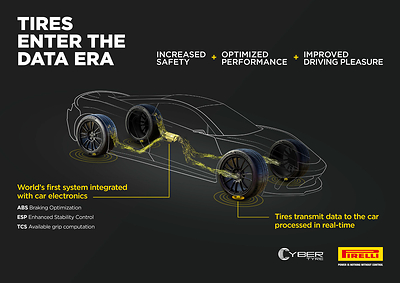
Pirelli says tire identification allows traction control to adapt its settings to the characteristics of the tires installed. For anti-lock braking, or ABS, the system also supplies information about the tire’s point of maximum grip, which the company says can help shorten stopping distances.
The integration goes beyond displaying tire readings to the driver. Bosch, Pirelli’s development partner, has confirmed that it created an electronic stability-control application for the Pagani Utopia Roadster that uses information from Cyber Tyre.
Pirelli also says tire data can help detect hydroplaning risk earlier and support driver-assistance systems. Its U.S. announcement does not provide measured braking-distance improvements or detailed test conditions, so those benefits remain company claims rather than independently established results.
What the Pagani example shows
The Pagani Utopia Roadster already uses the technology. According to Pirelli, sensors in each tire allow the car to select tire-specific settings and adjust torque management based on tire type and temperature. The driver also receives dedicated information through the infotainment system.
For drivers, the important distinction is that the tires, software and vehicle electronics work together. The announcement does not provide U.S. retail pricing or a vehicle-by-vehicle rollout schedule, and it does not describe a universal retrofit option for existing cars.
Georgia production is a longer-term plan
Pirelli says its expansion program is scheduled to begin in 2027 and gradually increase the Rome plant’s capacity to approximately 6 million car tires annually by 2033, with approximately 1,000 new jobs expected. That capacity figure covers the plant’s car-tire production, not Cyber Tyre-equipped tires alone.
The project includes upgrades to Pirelli’s robotic manufacturing technology and a new, fully automated conventional production line for premium tires. Tires equipped with Cyber Tyre will be among the products made at the facility.
The Georgia Department of Economic Development also announced the $1.2 billion expansion on Sept. 22, 2026. Its announcement says the bulk of hiring is expected to begin in 2029, with full operations projected for 2033.
Beyond individual vehicles, Pirelli identifies road monitoring as another use for the technology: tire data could help flag road hazards and inform maintenance planning. For now, the practical development is the U.S. introduction and planned local production, not a broadly available upgrade that drivers can buy for any car.


Comments 0
No Readers' Pick yet.