








EcoFlow vs Jackery: Which One Is Worth Your Money?
 Story by:
Technology Blog
Story by:
Technology Blog
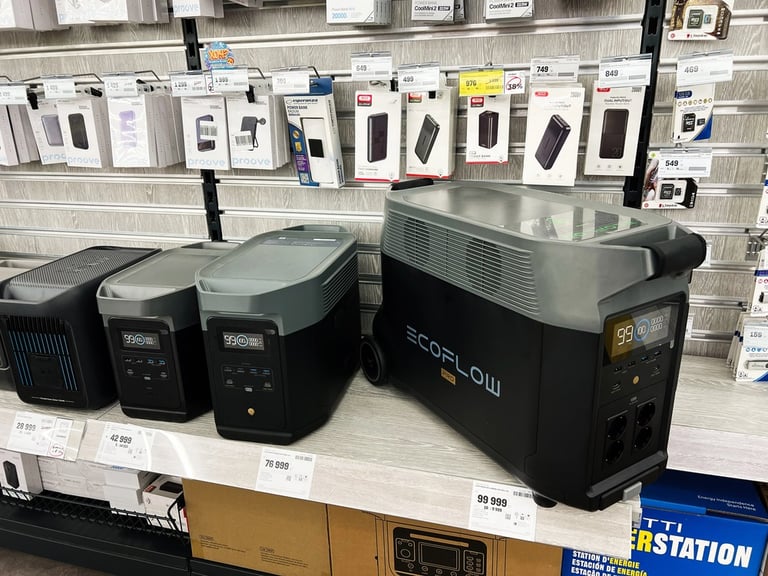
While EcoFlow and Jackery are the market leaders of portable power stations, they achieved their leading roles in different ways. EcoFlow is leading in charging speed and smart technology. You can also count on it when making a date plan, because then you won’t have to be concerned with anything other than having a great time together before you go on a trip, have an outdoor picnic, or spend the evening under the stars.
Jackery is the pioneer in providing portable products and easy-to-use designs. It’s a matter of preference for what you are looking for in your setup: fast recharge, ultra-lightweight, app control, or low cost. The two brands have some similarities, but significant differences in fine detail that make for use in everyday situations. The features, actual performance, and value for money of both lines are highlighted and contrasted in this guide so you can choose the best portable power station for your needs and budget and get it right the first time.
Two Brands, Two Design Philosophies
EcoFlow and Jackery each claim a leadership role, but they built their reputations on different strengths. Both use LiFePO4 battery chemistry, offer five-year warranties, and sell matched solar panel ecosystems. The core technology overlaps more than most buyers realize:
- LiFePO4 cells rated for 3,000–6,000 charge cycles
- MPPT solar controllers for efficient panel recharging
- Pure sine wave inverters are safe for sensitive electronics
The split emerges in execution. EcoFlow packs more technology into each unit, faster inverters, deeper app control, and higher solar input ceilings. Jackery strips weight and complexity to make every gram count. Choosing the right portable power station comes down to which trade-offs you accept. EcoFlow wins on speed and smart features. Jackery wins on weight and simplicity. The sections below show where each excels.
Head-to-Head on the Specs That Matter
Spec sheets from both brands look similar at first glance. But dig into these five categories and the real differences emerge, showing where one brand pulls ahead and where it trades off.
Charging Speed
EcoFlow charges most units from 0 to 80% in under 50 minutes via a wall outlet, using its proprietary X-Stream technology. Comparable Jackery models typically need two to four hours for the same fill. If you pack gear last-minute, that speed gap is hard to ignore.
Output and Capacity Range
Both brands cover a range from roughly 300Wh to over 3,600Wh. EcoFlow’s DELTA Pro series expands up to 48kWh by stacking extra battery modules, making it a strong contender for home backup. Jackery’s Explorer Plus lineup reaches comparable limits through its own modular system.
Weight Across Size Classes
Jackery consistently builds lighter units across matching capacity ranges. In the 500–1,000Wh class, their stations tend to shave several pounds off EcoFlow’s equivalent. For hike-in campsites, that weight gap matters.
App and Smart Integration
EcoFlow’s app is the best in the portable power station category with real-time monitoring, control, on/off, firmware updates, and compatibility with smart home devices. The basic details, such as whether it is charged or not, are included in Jackery’s application, but there is no detailed customization. That may mean there are fewer things to fine-tune before heading out on a road trip or outdoor date, but the essential functionalities are still simple to use and reliable.
Solar Charging Performance
Both brands use MPPT controllers for solar recharging. EcoFlow’s DELTA 3 series accepts up to 1,000W solar input. Comparable Jackery models accept less. Higher input means shorter daytime charging windows.
Matching Each Brand to Real Camping Scenarios
Raw specs tell half the story. Your trip style, gear list, and charging access determine which portable power station performs better in practice. Before comparing models, answer these three questions:
- Do you need wall-charging done in under an hour?
- Will you carry the unit to a hike-in campsite?
- Do you want smart home integration during power outages?
| Scenario | Advantage | Why |
|---|---|---|
| Weekend car camping | Tie | Both handle 1–2 nights easily |
| Home backup | EcoFlow | 10ms UPS + smart panel |
| Multi-day off-grid | Depends | Weight vs solar speed |
| Remote work | EcoFlow | Fast charge + USB-C PD |
Weekend Car Camping
Both brands handle short trips well. EcoFlow’s fast wall charging tops off the battery in under an hour before departure, a genuine edge for last-minute plans. Jackery’s lighter builds slide into a packed trunk more easily.
Home Emergency Backup
During power outages, the 10ms UPS switch-over ensures that the critical devices continue to operate without being affected. Jackery provides UPS on certain models, but the compatibility of the transfer switch and the smart panel integration on EcoFlow models has an advantage in terms of whole-home backup.
Multi-Day Solar-Powered Trips
Solar recharging is required, as are large capacities for extended trips. Using foldable panels for camp use, both brands fit. The lighter models of Jackery can be moved easily between camps and charging areas. With a greater solar input, EcoFlow reduces the amount of time it takes to charge daily, and extends the hours of the trail.
How the Pricing Stacks Up
Sticker price alone rarely tells the full story on a portable power station purchase. A unit you use for a decade costs far less per charge cycle than one that wears out in three years. Before making a final decision, weigh these three factors carefully:
- Price per watt-hour of stored capacity
- Charge cycle rating and expected lifespan
- Bundled accessories like solar panels or carrying cases
| Feature | EcoFlow (DELTA series) | Jackery (Explorer series) |
|---|---|---|
| AC Charge Speed | 0–80% in ~50 min | 0–80% in 2–4 hrs |
| Smart App | Full control + smart home | Basic monitoring |
| Typical Weight | Heavier per Wh | Lighter per Wh |
| Best Strength | Speed + ecosystem depth | Portability + simplicity |
What Cost Per Cycle Reveals
A $500 station, running for 3,000 cycles, runs about $0.17 per cycle. A $300 unit rated for 1,000 cycles runs $0.30 per use, nearly double. Now, both brands deliver a battery with a cycle life above 3,000, hardly a large difference.
Myths That Mislead Buyers
There are a few lingering rumors about both brands that are common on online reviews and forum threads. Overcoming these enables you to compare on solid information rather than impressions or old information. Three common claims deserve a closer look.
“Jackery Always Wins on Weight”
For the range between 500W and 1,000W, Jackery tends to craft lighter stations, with these models expected to weigh a couple of pounds less. However, at over 2,000Wh, there’s not much difference in weight between the two. Always consider specific models with capacities you’ll need and never make an assumption that one brand will be lighter in general.
“EcoFlow’s App Makes It Complicated”
The app is entirely optional. Any EcoFlow portable power station works straight out of the box — press the power button, plug in your gear, and go. Smart features add control but never add mandatory setup steps. The base experience is just as simple as Jackery’s.
“More Expensive Always Means Better”
No brand is best at all levels at all prices. Jackery is a player that has some real advantages in the ultralight portable space, where the end-user is looking for simplicity. EcoFlow’s mid-range and higher-capacity options offer greater bang for your buck, particularly when charging speed and smart capabilities add up over time.
What is the Value of a Portable Power Station?
The advantages of a portable power station will make it worth your money if you can charge quickly, have long-lasting lithium iron phosphate batteries, have smart monitoring, and can grow along the way. Those features are also great for special occasions, to be sure, and can help keep your devices charged up while you’re on a weekend getaway, an outdoor dinner, or a camping trip, where the center of attention should be on the time spent together.
EcoFlow’s DELTA and RIVER series hit all the marks: fast wall and solar charging, a battery health metering app that lets you monitor battery health in real time, and modular expansion for future upgrades. This mega evolution in portable power design gives buyers seeking speed, smart controls, and a long-term product ecosystem every scenario covered, from a weekend campout to extended whole-home backup with no compromises.


Comments 0
No Readers' Pick yet.