



How Poker Players’ Fashion Choices Help Them Win Games
 Story by:
Casinos and Gambling Blog
Story by:
Casinos and Gambling Blog
At a televised final table, the camera will hold on a player adjusting his hood for ten seconds before any cards move. The play arises from the fact that what players wear affects the way their opponents see them at the table. If you have a hoodie pulled tightly around your face, you will reduce the amount of information out there about you, and in the process, create some level of ambiguity. A pair of dark sunglasses removes more. A pair of sound-blocking headphones removes the rest. The functional purpose of poker attire is to limit the information leak from one player to the next, and the players who win the most tournaments have spent decades refining how much information they choose to give up.
The Functional Case for Sunglasses
Pupil dilation responds involuntarily to emotional arousal. A strong starting hand triggers measurable dilation within milliseconds. The reaction is small but readable across a table at close range. Dark lenses cover the response. Sunglasses also conceal gaze direction. A player watching one opponent rather than another signals where the read is being formed. Even reflective-coated lenses, which read as flashy on broadcasts, block the eye-tracking signal completely.
The most consistent users at the top of the live circuit have run the same eyewear setup for years. Daniel Negreanu wears prescription frames with photochromic lenses that darken under the table lights. Phil Ivey has worn the same Oakley-style sport frame in nearly every World Series of Poker final table appearance. The consistency builds a recognizable visual brand and removes one variable the player has to think about before the cards are dealt.
The Hoodie as Information Block
Phil Laak earned the nickname “The Unabomber” for wearing a hoodie pulled tight around his face during big decisions. The visual matched a famous forensic sketch closely enough that the name stuck. The original hoodie was a gift from Gus Hansen. Laak has worn variations of the same setup for two decades. The hoodie does work that sunglasses cannot. It hides neck pulse, breathing rate, and the small head movements that strong players track when they suspect a tell. A player wrapped in a hooded sweatshirt during a long hand can sit completely still for several minutes, give up no facial information, and force every read onto bet sizing alone. The strategy compresses the opponent’s decision space and shifts the game toward pure math.
Headphones and Their Tactical Use
Headphones serve two functions at once. They block ambient table chat and crowd chatter, which lets the player focus on bet sizing and timing, and tells the adventurer’s time. They also signal disengagement. A player wearing headphones at a televised table is broadcasting that he is not interested in the table conversation, which discourages opponents from probing for verbal tells. Some players use the headphones as theater rather than for actual music. They are paused or play nothing during important hands while remaining visually in place. The opponent sees the headphones and assumes the player is distracted. The player is actually listening to every breath and chip stack click around the table. The setup creates a one-way audio advantage that costs nothing in real attention.
The Image Layer and Persona Building
The functional rationale stops short of explaining what Phil Hellmuth wears. Phil Hellmuth has arrived at recent World Series of Poker Main Events dressed as a Roman gladiator, a championship boxer, and a giant baby. The costumes generate broadcast time and tilt opponents who underestimate him or take the entrance personally. Hellmuth has been explicit about the strategy. The shades, the black hoodie, and the costume are part of the brand, and the brand functions as a psychological lever every time he sits down to start playing poker at a televised table. Persona work is not limited to costume.
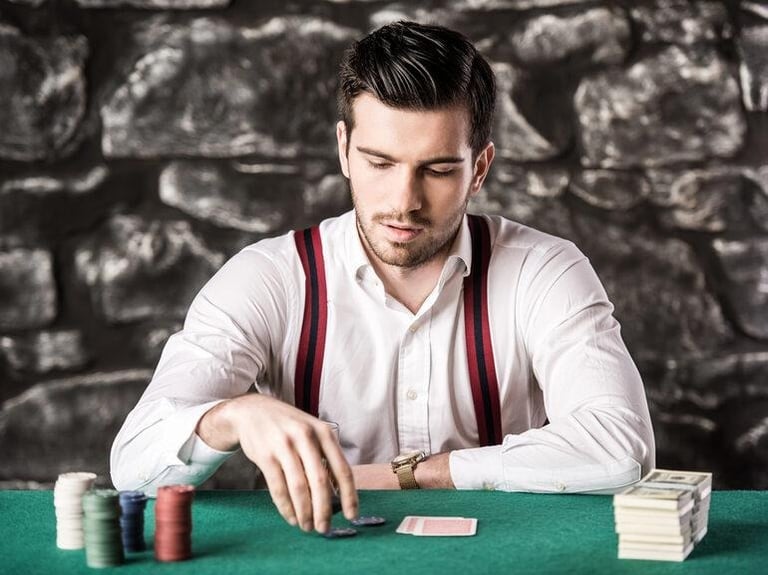
Some players build credibility through tailored suits, which signal financial discipline and steady decision-making. Others lean into the grinder aesthetic with worn hoodies and faded caps, which signals that the player is willing to log hours and grind small edges. Each image fits different stakes. The wrong image can be expensive. A new player in a suit at a $1/$2 cash table will be marked as soft and targeted accordingly. The opposite mismatch is also penalized. A player in a hoodie at a $25/$50 nosebleed game will be assumed to be a backed grinder rather than a wealthy recreational player, which changes how opponents size bets against him for the entire session.
Sponsorship and Branded Apparel
Player apparel during major tournaments is now mostly contracted. The cap, shirt, or jacket worn at a televised final table is part of a sponsorship deals that pay in the high five figures for a deep run on a major broadcast for special days. Sponsors require their logos to be visible during the entire broadcast, which constrains what players can wear above the waistline. The constraint changes how players think about gear. A player without a sponsorship deal is free to wear whatever functions best.
A sponsored player has to coordinate function with brand placement, which means hoodie color, cap style, and even sunglass brand are negotiated months before a deep run. The result is a more uniform visual product on broadcasts and a tighter set of options for sponsored players. Some players have walked away from sponsorship offers specifically to preserve the right to wear whatever blocks the most tells.
Personal Discipline Through Dress
The cumulative effect of consistent table attire is psychological. Players who wear the same setup at every tournament report a routine effect, where the act of dressing for the table puts them into competition mode before the first hand is dealt. The pre-performance routine matches what athletes describe across most professional sports, with a fixed wardrobe acting as a psychological cue to enter performance mode. The clothes function as a uniform. The uniform removes one decision from the pre-session checklist, which leaves more cognitive room for the decisions that actually matter at the table.
Those who look at dressing up as part of their preparation will stay for longer in the deep tournament rounds than those who view it simply as something else that follows later on, especially as they progress into the upper tiers of the live tourney circuit. Likewise, how one dresses in everyday life could make some difference to how others react to them in their social and romantic settings, where personal grooming is often a factor alongside other factors such as personality and conversation when forming a first impression.


Comments 0
No Readers' Pick yet.