







An Interview With Ray Deptula, Former U.S. Naval Aviator and Author of A Dog Before A Soldier

 Story by:
Editorial Dept.
Story by:
Editorial Dept.
History is usually told from one side. When it comes to the American Revolution, that side is ours.
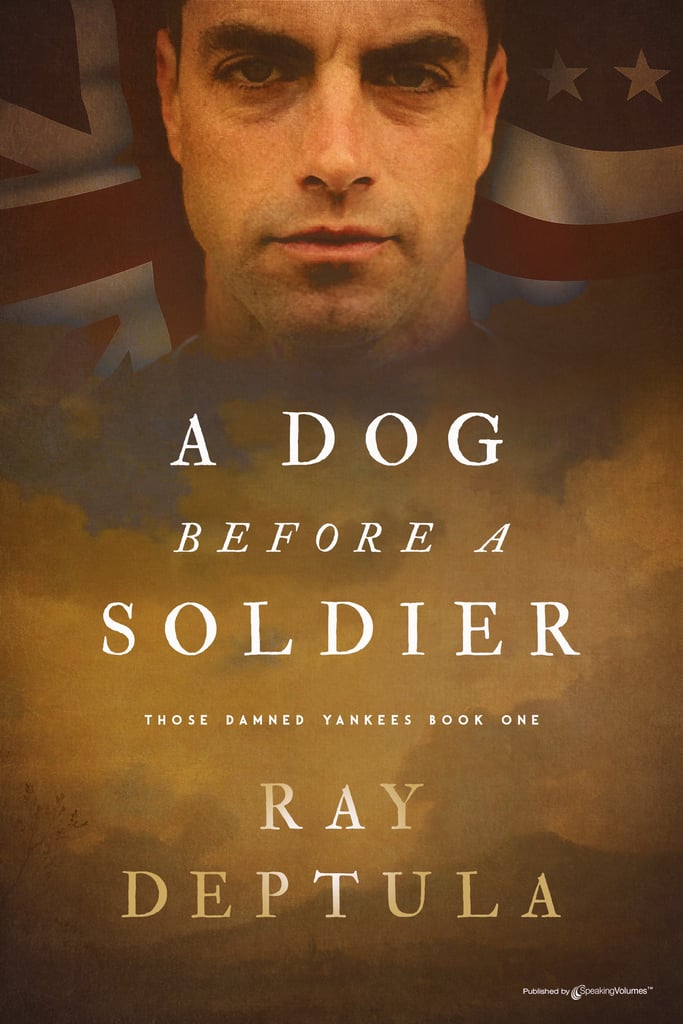
Author and 24-year U.S. Navy veteran Ray Deptula takes a different approach. His novel A Dog Before a Soldier tells the story through the eyes of a British foot soldier, an ordinary young man caught in a war he does not fully understand. The focus shifts away from strategy and politics and toward survival, identity, and what it means to serve.
Drawing from his own military experience, Deptula brings a grounded perspective to the relationships, pressure, and uncertainty that have defined all military conflicts, from ancient history to the modern day. The result is a story that is surprisingly relatable and human.
We spoke with Deptula about the real experiences behind the book, the parallels between the Revolutionary War and modern conflicts, and why looking at history from the other side can reveal something closer to the truth. You can purchase A Dog Before a Soldier from his website. Keep reading for the full interview.
What made you want to tell the story of the American Revolution from the perspective of a British soldier?
We, as Americans, tend to be taught our history solely from our own perspective. Twenty or so years ago, I had a chance to attend a year-long master’s degree program at the U.S. Naval War College in Newport, Rhode Island, where we studied the relationships between the government, the military, and the people for numerous conflicts dating back to the Peloponnesian Wars in ancient Greece. This was a holistic, objective, neutral perspective that I grew to like. But my story is not really about the war as much as it is about a young man who is simply doing his best to find his way in the world. This story could have actually been written using any war, but I wanted to highlight the American Revolution in particular because, in a large way, it was the British version of our Vietnam War. I thought it would be both fascinating and instructive to tell the story from the perspective of a lowly British foot soldier who, much like young soldiers throughout history, has little understanding or control of his participation in a conflict that he could not avoid.
How did your 24-year career in the U.S. Navy influence the way you approached this story and its themes?
I believe that relationships in the military are timeless – that they have not changed and never will. When you are involved in an operation, whether simulated or real, your only concern is doing your job and protecting your teammates. I obviously was not around during that time period to observe relationships, so I simply transposed those that I experienced myself over the course of my career. There is no single character in the book that is an actual person; however, I built my characters around the types of people that I saw over and over again. There are many such military stories that do not get the personal interactions correct, and, as a veteran, that irritates me greatly. I wanted this story to feel like it could have been written for any military in any time period, and I drew heavily from my own personal experience because I believe that my experience was not at all uncommon.
You’ve mentioned parallels between the American Revolution and more modern conflicts like Vietnam. What similarities stood out most to you, and how did they impact your approach to the novel?
I mentioned before studying at the Naval War College. I took a Revolutionary War elective where the professor, who was a retired Marine Corps infantry officer, had the premise that “those who fight their nation’s wars are typically those who can least avoid it.” He was referring specifically to the American Revolution on the colonial side, but I think that is true for most any conflict. This was certainly the case during the Vietnam War, which was wholly unpopular at home due to a dysfunctional relationship between the government, the military, and the people, just as it was for Great Britain in the 1770s. Much like America with Vietnam, Great Britain was the world’s superpower that took on a greatly inferior military opponent and somehow managed to lose. Moreover, to be a common soldier in a standing army on either side was the lowest form of human existence and an act of desperation. The parallels between Jack and a Vietnam veteran are easy to make because both were forced to do a horrendously dangerous and unpleasant job for their country, yet looked on as if they were criminals.
What about Jack Halliday makes him a good character to experience the American Revolution through?
Jack is basically an everyman who has abilities and leadership qualities he does not even realize he possesses. Like countless people who enter the military because they can find no better options at the time, he finds a real home. Honest, caring, and peaceful by nature, ironically, his main attribute becomes his ability to fight. He cannot understand the politics of the situation that is driving the unrest, and more importantly, cares little, as his main focus is on doing his job. Jack is a reflection of the fledgling nation of 13 American Colonies as he grows into every challenge that is set before him with a steadfast determination and unwavering moral compass. The experience of the American Revolution through Jack is at the most basic level of a common soldier, which embodies the most honest perspective.
While conducting your research, did anything you uncovered shape the direction of the novel?
While I wrote much of the story from personal knowledge, I did have to conduct significant research. In doing so, I was continually struck by the disparity in leadership, particularly on the American side. While George Washington does not appear personally as a character in the book, his fingerprints are all over the story. All this while at the mercy of the constant infighting by those in a corrupt Congress, many of whom wanted to replace him for their own agendas. I was struck by the similarities in behavior between our modern leadership and the political polarization that exists today. I can only conclude that such dysfunction is a permanent condition of our human existence. For this reason, I made sure that Jack, who is himself at the very bottom of society, rises above the very flawed behavior that continually drives his circumstances.
As historical fiction, the novel sets fictional characters in well-known moments from history. How did you balance accuracy with storytelling?
In order for me to be unencumbered to tell the story, I had to be absolutely historically accurate. With the historical timeline and events as a blueprint or even a foundation, I had something to build on and draw creativity from, as the imagination became easier once I was confident that the setting was undeniably correct for the reader to picture. The story does contain a heavy dose of history – almost non-fiction in much of it, but I felt that was important to enhance the relevance of my fictional characters. The biggest challenge I had was not going down rabbit holes because there is just too much interesting history available.
The novel does not shy away from darker moments in American history, such as slavery. What was it like trying to respectfully incorporate those elements into the novel?
To be honest, it was an area that I really enjoyed as I felt I was able to tap into my strongest vein of creativity. Slavery was an issue that was at the forefront of daily colonial life, whether you lived in a province that heavily employed it, such as those in the south, or in a province that generally opposed it, such as those in the north. Outside of America, the global slave trade itself flourished as an economic enterprise. But if I was going to take on the concept of slavery, I vowed to do so in a way that did not have an agenda except to brutally expose the historical realities of the period and use those realities to further the story. I chose to open the book with a runaway teenage Jack as crew on a slave ship, as I wanted to place him in a shocking situation in order to demonstrate his level of desperation. I used to work in West Africa and am familiar with that part of the world, including its history. Near the end of the book, Jack is taken in by a wealthy landowner and is befriended by one of the slaves, Custis, who is not necessarily what one might consider a prototypical example of an indentured captive. The relationship between Jack and Custis is by far the strongest theme in the series that I used to promote the idea that friendship and loyalty can transcend even the brutal realities of slavery.
Readers are familiar with battles like Lexington and Concord and Bunker Hill. How can Jack’s perspective of how it unfolded change how readers view the battles themselves?
I used both battles, in particular, to demonstrate how horrific it would have been for anyone to have participated in those actions and also to draw parallels to Vietnam on a tactical military level. The British decision to march on Concord was an ill-conceived and desperate measure to begin with, as military commander General Gage ordered it as a way to appease King George with some kind of action in order to save his job and reputation. Jack and his comrades were tasked with marching 20 miles west of Boston to Concord in the middle of the night to confiscate illegal weapons. Ironically, the soldiers themselves were the only ones who did not know what was about to happen, as the entire population surrounding Boston had been expecting them. We as Americans are taught that the colonial defense was a patriotic response – and it was. But imagine it from Jack’s perspective – trudging through a strange land to who knows where to do who knows what, only to be shot at by an invisible enemy hiding in the woods as he and his fellow soldiers must fight for their lives the whole next day to return to the safety of Boston. The British lost 20 percent of their 1,500-man force on the road back from Concord and were lucky not to be completely annihilated. This would have been utterly terrifying for a young man such as Jack, who was trying to do his job but had little understanding as to why he was there to begin with. Jack was never the same after this, as it scarred him for the rest of his life.
Themes of identity and belonging run throughout the book. How does Jack’s shifting role reflect larger ideas about loyalty and nationhood?
Even though a British subject with no ties to America, Jack ironically embodies what we would consider the American character – determination, honesty, self-reliance, and empathy for his fellow man. Jack’s role shifts throughout the story from a deckhand on a slave ship to a British soldier to the ward of a wealthy landowner to a Continental soldier and finally to a retired recluse. But throughout the entire period, his one desire remains the same – to belong to a home and family where he is valued. Jack also does not have many friends, and he chooses them carefully, but to the ones he has and also to those he respects, he remains exceptionally loyal. Jack could have abandoned Custis numerous times, but is loyal even to his own ultimate detriment. Jack’s journey from an unlikely accident of birth in a dysfunctional family to a respected leader and stalwart friend is in many ways a microcosm of the formation of America from a disparate and quarrelsome 13 colonies into a functional and enduring country.
This is the first book in a series. What can readers expect from Can’t Find My Way Home, and how does it build on this story?
I originally wrote the series as a single book, but my literary agent convinced me that it would be more impactful if it were split into two parts. The first book, A Dog Before A Soldier, which traces Jack’s experience as a British soldier, is actually a foundation for the second book, which delves into Jack’s service as a Continental soldier along with the slave, Custis. It is Jack’s relationship with Custis that dominates the entire series as the pair must continually navigate a cruel world that seeks to exploit Custis as a commodity instead of valuing him as a human being, as Jack does. I wrote the first book on mainly an intellectual level, but for the second, I relied almost entirely on my subconscious, and I was quite honestly shocked by what emerged. In my opinion, Can’t Find My Way Home is the better of the two books.
Ray Deptula is a native of Wells, Maine, and a graduate of Maine Maritime Academy in Castine, Maine. He spent 24 years in the U.S. Navy as a Naval Aviator and a Political-Military Officer with service in Europe, the Middle East, Africa, and the Caribbean. He is a graduate of the U.S. Naval War College in Newport, Rhode Island, with a Master of Arts degree in National Security and Strategic Studies. He lives in Merritt Island, Florida, with his wife, Julia.

Comments 0
No Readers' Pick yet.