





World Legends of the Blade: Which Male Fencers Have Gone Down in History
 Story by:
Sports Blog
Story by:
Sports Blog
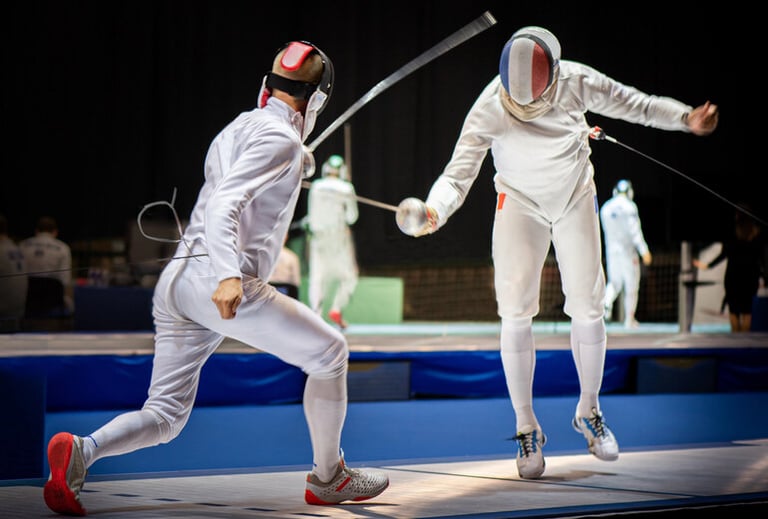
The first modern Olympic Games consisted of fencing. In 1896, three groups of medals among men were given in Athens. In addition, the fact that fencing was the sole sport in which highly skilled amateurs or experts in the training of cold weapons were invited to the sport was also peculiar. Such competencies and accuracy made legends on the podium. A comparable form of expertise counts in the dating realm: boldness, subtlety, and the ability to maneuver relationships can make otherwise banal relationships something to remember.
It is just like fencing rewards, as they focus and strategize, dating works when individuals carry the intent, awareness, and timing to each date, and moments become precious and special. Who are they who can be referred to as the real legends of the blade? The four fencers we have chosen are those who have made the most spectacular performances at the Olympic Games. If you want more sports and excitement, then this is the place for you – NBA betting lines at Betwhale Sportsbook.
Edoardo Monjarotti (Italy)
3 Olympic medals
- 6 gold (1936 — épée, team; 1952 — épée, individual and team; 1956 — épée, team, sabre, team; 1960 — épée, team)
- 5 silver
- 2 bronze
Had fencing been a religion, Edoardo would be the supreme god. The statistics provided by the Italian are astounding; 13 Olympic medals, 6 of which are gold! It is a record of all time. The Italian might have certainly gained more. In 1940 and 1944, however the World War II led to the cancellation of the Olympics. However, despite the twelve-year gap, he is number five in the world as per the number of medals won. And he triumphed three times in the world championship! Mangiarotti had mastered all three kinds of weapons, namely the épée, sabre, and foil; all of this already speaks of his genius. But there was no branch upon which he was regarded as a god more than in the sphere of épée.
Suppose that an athlete had the reaction of a cobra and the mind of a chess grandmaster. The style of Edoardo was classical fencing, done to the extreme. Impeccable defence, lunges, flawless footwork. He did not stab; he calculated three steps beforehand, as a master gambled his pawn to checkmate, much like strategizing which companies to enter chess tournaments might do to outmaneuver rivals. His lunge was a bolt of lightning, accurate, strong, and unavoidable. The initial successes of Edoardo were when he was 16 and retired after the Olympics in Rome when he was 42. It is an enormous amount of time spent on the fencing piste.
Aladár Gerevich (Hungary)
10 Olympic medals
- 7 gold (1932 — sabre, team; 1936 — sabre, individual and team; 1948 — sabre, team; 1952 — sabre, team; 1956 — sabre, team; 1960 — sabre, team)
- 1 silver
- 2 bronze
The other veteran is the gold medal winner in this sport among men in fencing. At the age of 28, his international career was impressive. Gerevich, the first to become an Olympic champion (1932), in Los Angeles, at the age of 22, and when he got to Rome in 1960, at the age of 50, he sheathed his weapon. He won all six Olympic Games in first position.
His manner was a whirl, swift, sharp, and indefinable. Each of the steps was dynamic and remarkable and could not be neglected. Just like mastering the blade requires focus, similarly, the case of dating presence. Things that appeal to people are confidence, spontaneity, and electrifying moments. It is always remembered that people who are passionate and true to their lives make people bond and make them unforgettable, even without saying a word.
Christian D’Oriola (France)
6 Olympic medals
- 4 gold (1948 — foil, team; 1952 — foil, individual and team; 1956 — foil, individual)
- 1 silver
- 1 bronze
The International Fencing Federation (FIE) ranked him as the best fencer of the 20 th century. He had won three consecutive Olympics. Two individual competitions and two team competitions. The Frenchmen won four additional gold medals in the World Championships. He embodied charisma and mental prowess on the piste. He succeeded not by force but by his intellect. His sword fighting was likened to running an orchestra. He regarded the whole piste as a chessboard, foreseen the action of his opponent, and gave him the most fantastic and graceful responses. The fights organized by D’Oriola were regarded as art, ball dance with steel blades.After leaving the Melbourne Games (1956), he switched to épée, and a further 14 years were devoted to perfecting it. He had never won a significant international medal,s yet in France, he was a force to reckon with. In dating, there are no major victories or immediate recognition in which success is built. Like boxing or even different styles for self-defence, perseverance, drilling, and devotion frequently make a more lasting impact than transient successes. Good relationships are long-term. They require time, patience, and the silent confidence that comes with practice. The only people who gain trust and long-term respect are those who perfect their strategy rather than going after easy money.


Comments 0
No Readers' Pick yet.