








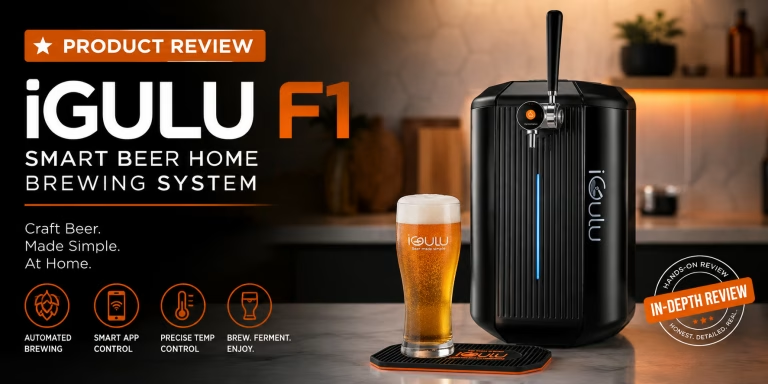
Product Review: iGulu F1 Smart Beer Home Brewing System
 Story by:
Eric Griffin
There’s something almost romantic about homebrewing. The reward of crafting your own beer from scratch, tweaking recipes, experimenting with ingredients, and then eventually pouring that first pint that only exists because of the time and effort you put in. But it takes time to get to that point.
Traditional homebrewing requires a considerable amount of equipment, space, patience, and cleanup. You’ve got kettles, fermenters, temperature controls, sanitization, bottling… not to mention waiting weeks for the finished product. While there are setups out there that do streamline the process and take up less space, it’s still not difficult to see why so many people never actually start, even if the interest is there.
Companies like iGulu have emerged with the hope to change that conversation. There’s no expectation for people to build a mini-brewery in their garage – rather, they’ve created an all-in-one smart brewing appliance designed to simplify almost every step of the process. With guided recipes, automated temperature management, integrated fermentation, and companion app support, the goal is approachability for those just getting into the game.
Our team was given an amazing opportunity to spend some hands-on time with the iGulu System, and we’re here to determine whether this countertop brewer is just another flashy gadget without the substance, or if it’s a legitimate tool capable of brewing beer that you’ll actually want to drink.
About iGulu
Founder David Zhang introduced the leading intelligent beer brewing technology iGulu in 2015, launched through an incredibly successful crowdfunding campaign. It attracted the attention of homebrewers and tech enthusiasts alike, both of whom were intrigued by the idea of an automated brewing system. Built around convenience, automation, and consistency, iGulu entered the market to help make fermentation accessible to everyday consumers.
And as the market’s landscape has evolved, so too has the product. Depending on the model, users can not only brew beer, but now they’re also able to produce hard ciders, wines, kombucha, sparkling beverages, and other fermented drinks while the machine handles most of the work behind the scenes.
The company’s philosophy is straightforward: revolutionize the world of craft homebrewing by removing as much of the intimidation from the process as possible without sacrificing the creativity that makes creating your own beverages enjoyable.
And their vision has resulted in immense success. Since 2015 they’ve won multiple awards for their products, including the CESInnovation Award in 2017 for a beer recipe that was selected for the launch of Hi Beer. Then again in 2024 they were voted one of the Best CES Products by Rolling Stone and featured in Food & Beverage magazine. The F1 Beer Brewer, a product first released to the masses in 2023, is what we will be looking at for this review. This advanced brewer has already won awards at various global craft beer competitions, and we’re very excited to share our experience!
What’s Included
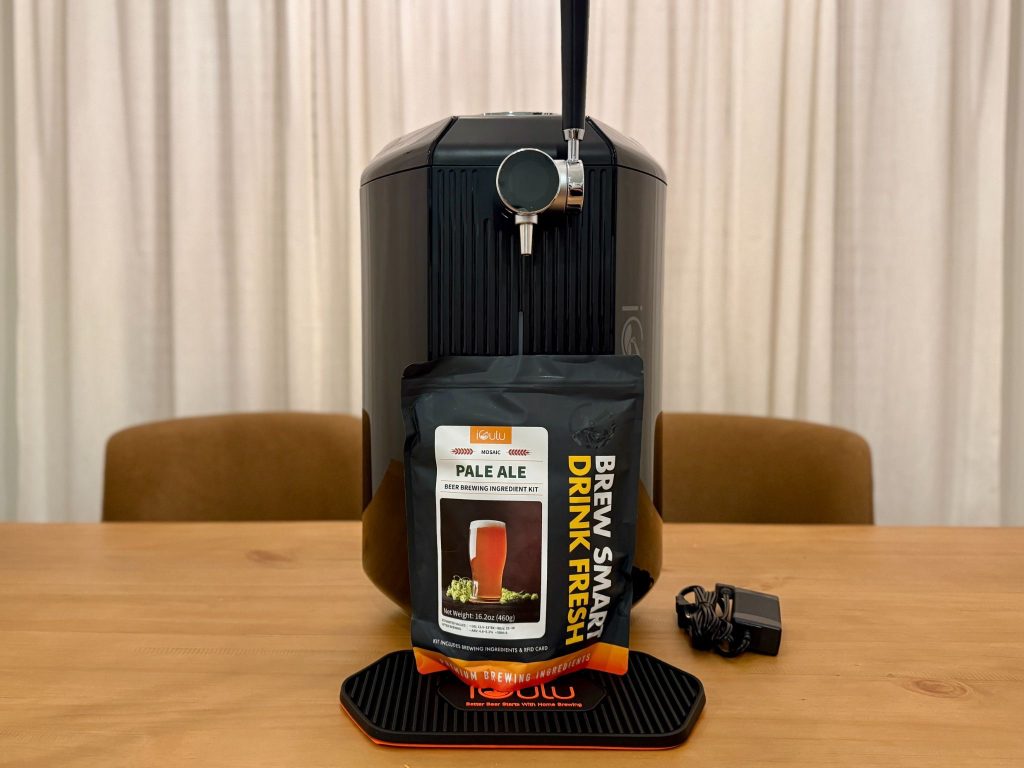
The iGulu F1 arrives as a nearly-complete system. The box includes the F1 brewing machine itself, the removable lid, an iGulu keg, dispensing tube (with an extra), AT dispensing coupler, tap handle, keg opener, power adapter, and drip tray.
The iGulu team was also nice enough to supply three different brew kits to test with this system:
It will be great to not only have three different experiences with the F1, but we’re also excited to try out three completely different products and the nuances each one may come with. Everything arrived well-packed, with nothing missing or damaged. That being said, there is one notable omission to this system that I feel like should be included, and that’s some form of sanitization solution. It’s certainly not a major expense in addition to the full system, and is one of the most important pieces of equipment for actually brewing. Given that F1 is positioned as an “all-in-one” brewing system designed to make the process more accessible, we feel like including at least enough sanitizer to complete the first batch without any secondary purchases would make sense. This small addition would really help to make the “open the box and brew” experience feel more complete.
It’s also important to note that a CO2 canister is not sold with this system. It’s not necessary for brewing with this machine, however it does matter if you’re wanting your finished batch to maintain its carbonation for more than 24 hours. With an external connection to CO2, iGulu states that the beer should remain carbonated for up to 30 days before it begins to noticeably fade.
Setup & First Impressions
Getting the F1 up and running was very straightforward, perhaps even more so than we anticipated. The only real point of confusion was about the CO2 canister. It didn’t initially seem clear that this wasn’t a part of the kit, and so there was some time spent searching the box again before realizing that A) it wasn’t a part of the setup, and B) wasn’t necessarily needed to brew. Once this was sorted, the setup was essentially plug-and-play.
App & Account Creation
With the machine unpacked and everything laid out on the table, the brewer was plugged up and the iGulu app downloaded.
Creating the account was straightforward, and the next step in the process was finding the F1 via Bluetooth before walking through connecting to Wi-fi. One thing to note about this step is that the system requires a 2.4GHz Wi-Fi connection. If your home network is configured exclusively for 5GHz, you’ll need to make sure a compatible network is available.
App Navigation
The app itself isn’t overly complicated, which is appreciated. The primary brewing interface gives you access to a Function button that displays the machine’s current pressure, temperature, and remaining time for the current stage. The settings menu provides access to things like:
- Device name
- Brewing history
- Device sharing with other users
- Device information
- Firmware updates
- Product deletion
The home screen also provides navigation to iGulu’s recipe library, which covers everything from beer, mead, and wine, to cider and kombucha. There’s also a profile section where you can customize your account, view coupons, and access your brewing history.
To this point, nothing about the app has felt unnecessarily complicated. It’s doing a lot without making the interface feel particularly overwhelming. It’s got everything you’d need for this particular utility, with no unnecessary fluff.
Brewing Experience
Initial Startup
The actual physical setup of the machine was even easier than the app. There’s essentially zero assembly required beyond removing and re-inserting the keg once the ingredients were added, and screwing in the tap handle. Once plugged in, the touchscreen will prompt you for pressure and temperature metric preferences, and then will remain idle with the product information and a QR visible for quick navigation while the app is set up.
The immediate first step before tearing open your selected brew kit is to make sure your equipment and workspace is sanitized. This is where that initial caveat we mentioned becomes relevant. So make sure you’ve got something like Star San on-hand. Once everything is sprayed down, the F1 isn’t all that intimidating. That said, there are a few components and connections that need to be positioned correctly before starting a batch.
Pre-Fermentation
The first step is filling the iGulu keg with purified water. For our first batch we chose the Mosaic Pale, which indicated filling exactly to the 116 fluid ounce mark. Beyond this, the instructions you would need are all provided on the back of the kit. You walk through adding and mixing ingredients in sequence. The pale ale required Mosaic hop aromatic and bittering extracts, followed by malt extract, and priming sugar. Be sure all of these ingredients are well-mixed.
The final ingredient is the yeast. Once that’s pitched, the mixture is to be left undisturbed. Be sure before placing the keg lid back on that you’ve properly positioned your sealing ring to the underside, as well as the clamping ring. The instruction manual will walk you through all of this so nothing needs to be eyeballed.
The final step before starting is activating the RFID tag included with the brew kit. This tag should be attached to the designated area within the “G” of the iGuliu logo stretching down the side of your machine. Once recognized, the touchscreen will walk you through the final few steps.
Then begins fermentation! The Mosaic Pale Ale has a start-to-finish time of 10 days, with 3 different fermentation cycles followed by 3 days of conditioning. The first stage is for 1 Day at 64.4°. But the beauty of the iGulu is that it’s just a waiting game at this point. There’s no mash tun, no kettles, propane burners, temperature controllers, airlocks, hydrometer readings… the list goes on. You just prep the ingredients, seal it all up, tell the machine what it’s brewing, and let it run.
Days 1 & 2
It’s mentioned above, but the app keeps things very simple. Once we had the system actively fermenting, the Function button became available at any time to view the current temperature, pressure, and Stage time remaining.
Day one went off without a hitch. The internal temp control did a great job of maintaining the target fermentation temperature of 64°F, only deviating 1-2 degrees from that set point. This is certainly a strong value point, being able to trust the system to keep important metrics like this accurate, rather than having to continuously monitor and adjust temperature manually.
As expected with the pressure, it didn’t start immediately. Nothing showed until Day 2, when the keg showed 1.35 PSI with about 8 hours remaining on that second day. Things got a bit more interesting midway through Day 3.
Unexpected Troubleshooting
We noticed that midway through Day 3 fermentation that instead of seeing the expected rise in pressure, we were seeing the PSI dropping. What didn’t make sense is when we pushed on the pressure safety valve, we heard pressure release, so therefore knew the PSI shouldn’t have been at 0.0. Turns out the problem was entirely user error.
Because we weren’t using a CO2 canister, we’d assumed during initial setup that the pressurized gas connector didn’t need to be attached to the keg. However, the F1’s built-in pressure sensor uses the gas port as the pressure path to that sensor. So even without that external canister attached, we still needed to go in and connect that to the keg in order to monitor pressure buildup. Once that was done, the PSI reading jumped up to 21.78 after just a few minutes. Nothing was wrong with the machine or the beer, just a simple misunderstanding of how the internal pressure-sensing system functioned. A small but good lesson to flag for new users!
Days 4 – 10
The remaining week of the process was uneventful. Regular check-ins showed clear signs of fermentation actively occurring, and the F1 continued doing a great job of managing temperature changes at each Stage and providing accurate pressure readouts without any manual adjustments necessary.
The Final Product
Tapping the Beer
As we rounded the corner toward the finish line, we decided to tap the beer with 7 hours left to go during cold conditioning. There weren’t any problems with the batch, we simply had family and friends visiting during the time and decided we wanted to share the finished product of this inaugural brew rather than miss the opportunity waiting for it to finish on schedule.
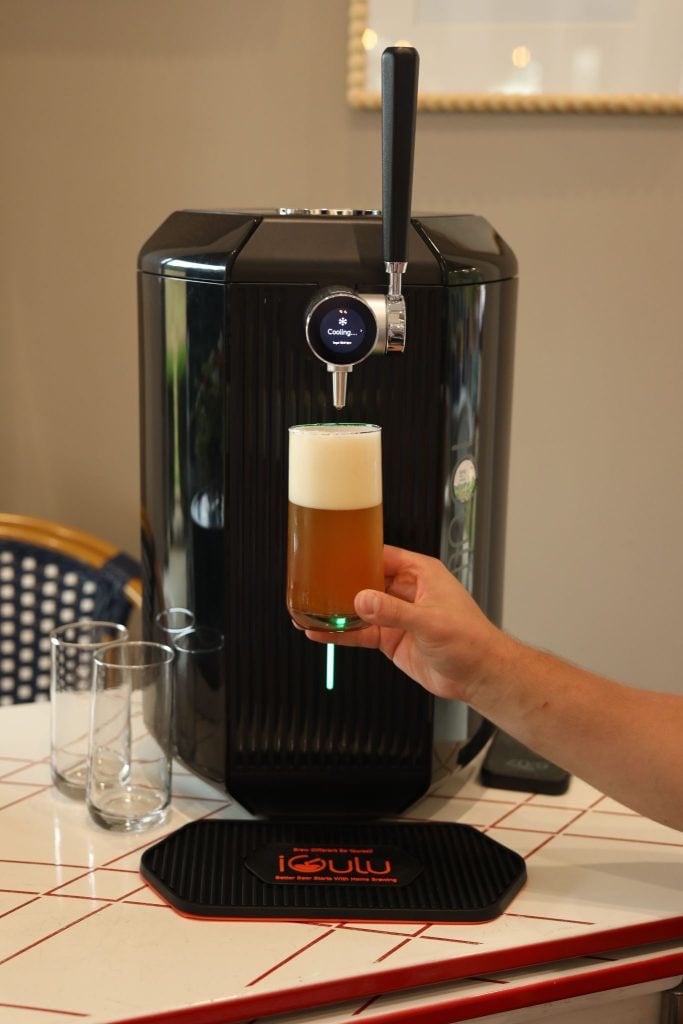
Proceeding with the plan, we found the serving preparation to be incredibly easy. Once we manually ended the brewing process, we switched the F1 into cooling mode and brought the beer down to about 36°F before serving. Because we didn’t use external CO2, we initially tapped the keg in Gas-Free Mode, making use of the naturally accumulated carbonation to pressure pour the first couple of glasses.
Once that had depleted, we switched the machine into Air Pump mode – a built-in dispensing system that uses the machine’s internal air pump to introduce air into the system and pressurize the keg – to allow us to continue pouring pints until the beer ran out. While this isn’t the recommended option if you were wanting to store the beer for more than a day, it was the perfect option for this scenario.
Reviewing the Beer
Of course one of the biggest questions about this whole experience was whether this all-in-one system that utilized a kit of extracts could produce a respectable finished product. And in short, we were very happy with the result.
The Mosaic Pale Ale turned out to be a very enjoyable beer, and the entirety of the group agreed. Starting out with the appearance, we expected it to not be quite what we would have expected if the beer had gotten to condition for another 7 hours. It poured a rust-hued golden with noticeable cloudiness. Had it gone the full cycle we would have expected the beer to develop a slightly brighter, clearer golden color. That said, for a Pale Ale recipe, the haze was perfectly on-brand and more importantly, didn’t contribute any noticeable off-flavors.
The nose was clean and citrusy, providing notes of citrus peel and an almost Lemon Head-like citrus candy quality. The bright aromatics were very much aligned with the style, and didn’t veer too much in either direction into being too aggressively resinous or tropical.
The palate mirrored some of the same, but did bring a bit more bitterness to a predominantly clean hop presence. With time and temperature, the beer introduced some subtly herbaceous notes alongside added layers of pineapple and lime. Nothing came forward in unwanted abundance, just enough complexity came to the forefront to keep things interesting.
The body and finish on the beer was probably the weakest component. As it traveled to the backend of the palate it died off quickly, without providing a huge amount of character that lingered into the finish. That said, it was incredibly drinkable, with a clean, very approachable profile that we felt was great for a wide range of palates. Again, for a beer brewed from a system like this in an automated countertop system, it was a pretty impressive result.
Cleaning & Maintenance
It was then time to get cleaned up. And thankfully, it was about as easy as we hoped it would be to get everything back in order.
We started by fully disassembling the dispensing system, detached the tubing, removed the faucet spout, and scrubbed the inside of the keg with hot water and dish soap. For smaller parts and tubing, a straw-cleaning brush worked perfectly for getting into those tight spots and removing any residual grime. Once everything had been cleaned and rinsed, it all got a spray down with Star San before being reassembled.
We made sure during this stage to be very cautious and position all components properly and airtight. Reassembly is not difficult, but because the F1 uses these tubing parts and connections for both dispensing and pressure management, it’s a step where you want to ensure nothing is being overlooked.
Overall, the process was straightforward, and didn’t really feel any different from what you would have to go through with traditional homebrewing equipment albeit with far fewer pieces to deal with.
Scoring Breakdown
Just to provide an easy, streamlined recap of everything we experienced, we wanted to provide a breakdown by category with scoring and brief notes for each.
| Category | Score | Notes |
| Setup & Ease of Use | 8/10 | Straightforward, with the one small learning curve around pressure monitoring. |
| App Experience | 10/10 | Simple, useful, and easy to navigate. |
| Brewing Process | 9/10 | Mostly automated from start to finish. |
| Hands-Off Automation | 8/10 | Very little intervention required. Saw occasional temp jumps that felt a bit too varied at times. |
| Build Quality | 9/10 | Solid, polished, well-designed system. |
| Cleaning & Maintenance | 9/10 | Easy to disassemble, clean and sanitize. |
| Noise & Smell | 10/10 | Virtually silent and completely odor-free. |
| Finished Product | 7/10 | Clean, drinkable, but limited complexity and depth. |
| Value | 10/10 | Excellent convenience for the price. |
| Overall | 8/10 | An impressive all-in-one brewing system. |
Who Is This For?
Now let’s get one thing straight here. The F1 isn’t going to replace traditional homebrewing for someone who loves the process, and the ability to have full control and responsibility over each variable in the process. But it was never trying to. This is for making brewing accessible, contained, and incredibly convenient.
This machine is for the people who like the idea of brewing, but don’t necessarily want to commit to the costs and dedication of becoming a homebrewer in the traditional sense. Beyond this, it’s got the extra perk of appealing to people who want to brew inside their house. Whether you live in an apartment, have no room in your garage, don’t have a basement, or whatever it may be, the compact feel of the F1, the sleek design, and the lack of noise and smell make it a perfect selling point for giving it a corner of your home.
Finally, this system appeals to people who enjoy variety. This isn’t just a beer brewer. This is a fermentation vessel. That means everything from sparkling wines, to cider, to mead… even kombucha. All are fair game for the F1.
In short, if you’re someone looking to prioritize convenience without having to sacrifice the satisfaction of making something yourself, this all-in-one system is going to make a strong case.
Final Verdict
8/10
This review has been a journey starting with an unopened box, going through fermentation, dealing with small troubleshoots, dispensing and enjoying the beer, and then cleaning it all up. After running the gamut, we’ve got to say we were impressed, maybe even more-so than expected.
Now let’s begin by noting that the F1 isn’t magic, and it doesn’t completely eliminate the work involved in brewing. Sanitization is still a very important responsibility, as well as ingredient prep and proper assembly. But once that batch is underway, it’s pretty amazing how little required intervention there is. And that’s where I really think the value prop here is.
The System
This system handles temperature control, fermentation, and pressure monitoring all while providing easy ways to check in throughout the process on a very well-built, straightforward app. While we ran into one troubleshooting issue with the pressure during our experience, this ended up being a user-error misunderstanding, not an issue with the machine. Following this, the rest of the brew cycle went off without a hitch.
The Design
As far as the physical machine itself, it’s another huge bonus worth highlighting. It’s compact. It’s quiet. And maybe the most surprising? There’s virtually zero smell. This is something that’s easy to overlook when comparing brewing systems, but it’s a pretty big deal when talking about quality-of-life improvements. No need to carve out garage or basement space, the F1 can set up shop wherever.
The Beer
And when we’re discussing the finished product, it’s really tough to hate on it. The Mosaic Pale Ale certainly wasn’t the most complex or layered beer we’ve ever had in the style. That said, it was clean, balanced, and incredibly crushable. Even more importantly, everyone who poured themselves a glass genuinely enjoyed it. Again, this is an extract-based kit we’re talking about here, brewed through an almost entirely automated system. With all that factored in, the result was pretty impressive. And it won’t stop here.
Versatility & Convenience
The iGulu team was generous enough to also send along a Sparkling White Wine and Kombucha kit, and we’re very excited to test the system performance on some other styles of fermented beverages. Of course for this product review, beer felt like the most appropriate place to start. That said, this ability to be able to move from beer to wine, kombucha, cider, mead and other beverages without needing an entirely separate setup transcends the use case well-beyond a single-purpose appliance.
And for those asking themselves “what’s next?”, the answer is going to come sooner than you think. iGulu recently launched the Kickstarter campaign for the F2 system, an AI-guided all-in-one system that still places a versatile focus on everything from beer, cider, and kombucha, to mead, wine and more. This new system will feature 2–40°C temperature control, 2–22 PSI pressure control, dual-pressure CO₂/air pump system, triple pressure protection, third-party keg compatibility, and expandable 1–2 gallon capacity. The campaign can be viewed here – with only 23 more days to go, a staggering $657,878 has been pledged (of a $10,000 goal), with nearly 1,000 backers. So if you didn’t believe us before that this is the real deal, here’s the proof that we’re not alone.
But don’t let that take anything away from the F1. It’s a system that delivers what an all-in-one brewing system should: less time managing the process, less equipment taking over your home, and more time enjoying what you made. And whether you want to try out this model for yourself or commit to the new-and-improved F2, the team here at The Beer Connoisseur are confidently giving the stamp of approval.


Comments 0
No Readers' Pick yet.