








Bitcoin is Moving Toward a More Orderly and Mature Market Phase, Reports Suggest
 Story by:
Finance and Investment Blog
Story by:
Finance and Investment Blog
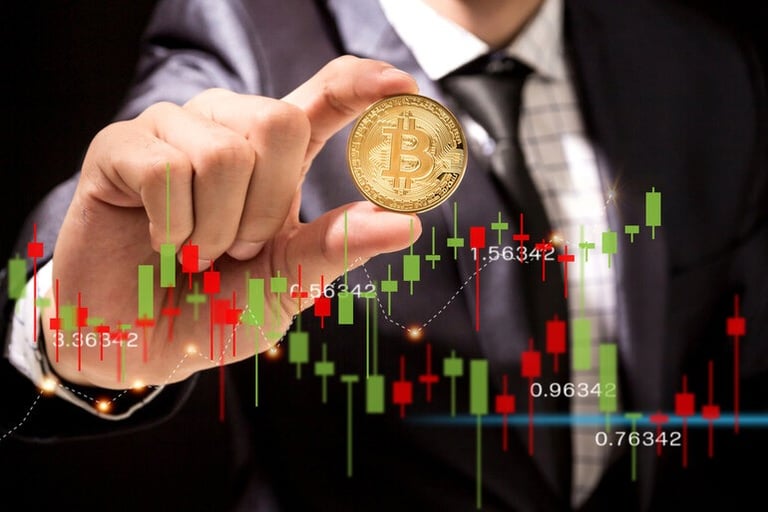
Bitcoin may start to teach investors a lesson in patience this year, if we take a look at the most recent reports from Glassnode and PwC, among other research hubs. It has accustomed the masses to chaotic movements, overnight spikes or drops, and everything in between, the type of volatility that’s so definitive of crypto. But as it approaches its coming of age on January 3, 2027, 18 years since the Genesis Block was mined, it’s also moving toward a more orderly and mature market phase.
After last year’s big drop, the excessive leverage, or the riskiest bets on BTC’s price direction, was wiped out, and as a result, Bitcoin became less fragile and less likely to fall suddenly if bad news hits the global economy. In dating, people also tend to value stability over unnecessary risk, making confidence and consistency more appealing than dramatic highs and lows. That broader preference for resilience offers an interesting perspective as investors continue to assess Bitcoin’s position in an unpredictable financial landscape. It continues to be regarded as the best cryptocurrency to date, and its branding is expected to evolve this year in ways that were previously not feasible, drawing interest in related investment options such as p2p bitcoin.
Bitcoin’s First Steps in 2026
October saw more than $19BN disappear in BTC liquidations, pushing the asset’s valuation down from the ATH of ~$126K to almost $89K, marking one of the most abrupt declines in history. In 2026, however, Bitcoin seems to be recovering, after it closed December at about $90K. Some more bullish analysts forecast a trading range of $130K to $200K for the asset by the end of the decade, while other voices believe the market will be more conservative. Still, numerous important price predictions envision Bitcoin surpassing its ATH this year.
Standard Chartered, a massive international bank across Africa, Asia, and the Middle East, believes Bitcoin can reach around $150BN close to the year’s end. Notably, earlier estimations from the heavyweight positioned it at $200K. For the more optimistic scenario to take place, interest rates should drop, and liquidity would need to increase, to say the least. Spot BTC ETFs, asset managers, and pension funds should continue to see capital inflows; demand from big investors like institutions should similarly increase, and regulatory frameworks ought to become clearer to support broader institutional participation.
Regarding the latter, progress is unfolding as we speak. The regulatory developments of last year have provided the clarity that institutional investors long demanded, even if we talk about the GENIUS Act that established the first comprehensive federal framework for stablecoins, or the EU equivalent, MiCA, framed to administer and harmonize crypto assets regulation across the union. At the same time, discussions around a strategic Bitcoin reserve in some jurisdictions have further highlighted Bitcoin’s growing importance within broader financial and policy conversations. The existing predictions are mainly grounded in the observation that Bitcoin is shedding its reputation as a speculative, retail-dependent asset and becoming a more mainstream and institutionally recognized investment vehicle.
Bitcoin Investors Tread More Carefully in 2026
As the first quarter of 2026 unfolds, BTC holders are showing less enthusiasm to open substantial positions. As found by Glassnode, the Net Unrealized Profit/Loss metric, which tracks the paper gains or losses across all BTC addresses, offers useful insights into investors’ caution. The indicator dropped from what analysts call the “belief” zone into “anxiety”, which helps explain why investors are no longer the frenzied buyers of yesterday. The message is clear: participants are still in the market, but they’re not rushing to make bold moves. This kind of cautious behavior isn’t unusual after significant drawdowns like the previously experienced one.
When NUPL stays in the anxiety range for extended periods of time, it can often indicate a consolidation period rather than abandonment. Investors haven’t dropped their positions but decided to wait for clearer signals before committing new capital or increasing exposures. This forbearance can also create potential advantages if conditions stabilize: when volatility stagnates and macroeconomic pressures ease, even modestly, sentiment can change unexpectedly fast. For now, though, the market remains in the “wait-and-see” mode.
Corporate Treasuries are Reshaping BTC Ownership.
Public companies trading on stock exchanges are using their treasury departments to allocate corporate funds into BTC, and as of October of last year, they held over 1 million BTC, roughly 5% of the supply in circulation. And the figure just keeps growing. Strategy, ex-MicroStrategy, led the top with 640,808 BTC by the end of October, and while purchasing rates have suffered a dip, it continues to buy under the Executive Chairman, Michael Saylor. Marathon Digital, MARA Holdings, Galaxy Digital, Block, and Tesla also partake in the growing list of publicly traded firms that are following suit, converting shares of their corporate reserves into what they view as digital gold.
If previous cycles were driven by retail investments and speculation, what we’re seeing now is nothing like that. These are calculated treasury decisions made by CFOs and boards of directors who’ve run the numbers on inflation, currency risk, and the scarcity economics of a capped-supply asset like Bitcoin. When such heavyweights invest in Bitcoin, they usually keep it locked for years, not weeks. This tightens supply available on exchanges and contributes to stability, reducing the kind of panic selling that defined earlier cycles. The result? A market that’s slowly but surely transitioning from speculative frenzy to institutional Bitcoin allocation.
What do All These Mean for Investors
Bitcoin’s transformation into a more stable, institutionally driven asset changes the investment game plan fundamentally; the wild fluctuations that once generated overnight fortunes, or losses, are giving way to more measured movements that resemble those in traditional financial investment vehicles. This shift also makes thorough investment analysis increasingly valuable for investors seeking to identify sustainable long-term opportunities. For the long-term holder whose portfolio would experience stomach-churning drawdowns every now and then, this is arguably good news. Reduced volatility means a smoother path to building wealth, even if the explosive gains of earlier cycles become less frequent.
That steady progress reflects a mindset many dating readers appreciate, where lasting results are often built through consistency instead of chasing every exciting moment. As Bitcoin continues to mature, that emphasis on stability may become one of its greatest strengths. Institutional participation brings credibility, but also competition. Retail investors now share the market with deep-pocketed entities like pension funds, corporate treasuries, asset managers, etc., operating with billion-dollar budgets and sophisticated strategies to predict market movements and mitigate risks. This doesn’t eliminate opportunities, but it does mean the easy money generated by simply buying and holding through predictable four-year cycles remains a story of the past.
Market Outlook
Bitcoin is entering a more mature phase, marked by lower volatility and greater institutional participation, reflecting the broader evolution of crypto assets as an established investment class. Success is increasingly reliant on patience, strategic timing, monitoring high-impact events, and understanding macroeconomic forces such as interest rates and liquidity cycles. These qualities also resonate with readers interested in building lasting relationships, where thoughtful decisions and a long-term outlook often lead to stronger outcomes than chasing short-term excitement. This broader focus on stability makes Bitcoin’s evolving market dynamics especially worth watching.


Comments 0
No Readers' Pick yet.