








30 Great Clever Riddles: Be Funny And Interesting Now

 Story by:
Kyle Boureston
Story by:
Kyle Boureston

Want to become a smarter person with these clever riddles?
Smart people love tricky riddles because they improve their critical thinking skills. As the resident trivia master, I know how to strengthen the mind through riddles and trivia. Look at these posts, that have garnered over a million views, about easy riddles with answers, general trivia questions, and unique trivia questions if you don’t believe me!
Excited? Let’s get started!
Contents


The Ultimate List of Clever Riddles to Put Your Intelligence to the Test

This is the ultimate list of clever riddles that will test your intelligence. Need a good riddle to tickle your brain? We’ve got them here. These short riddles will not only make you sound smarter but make you be smarter.
Riddle Categories


6 Best Smart Riddles To Test Your Logic

These are the best riddles for everyone – not just smart people, to enjoy. These short riddles will test your logic and reasoning ability and your ability to puzzle out the answer. So, if you want a challenge, try some of these great riddles!
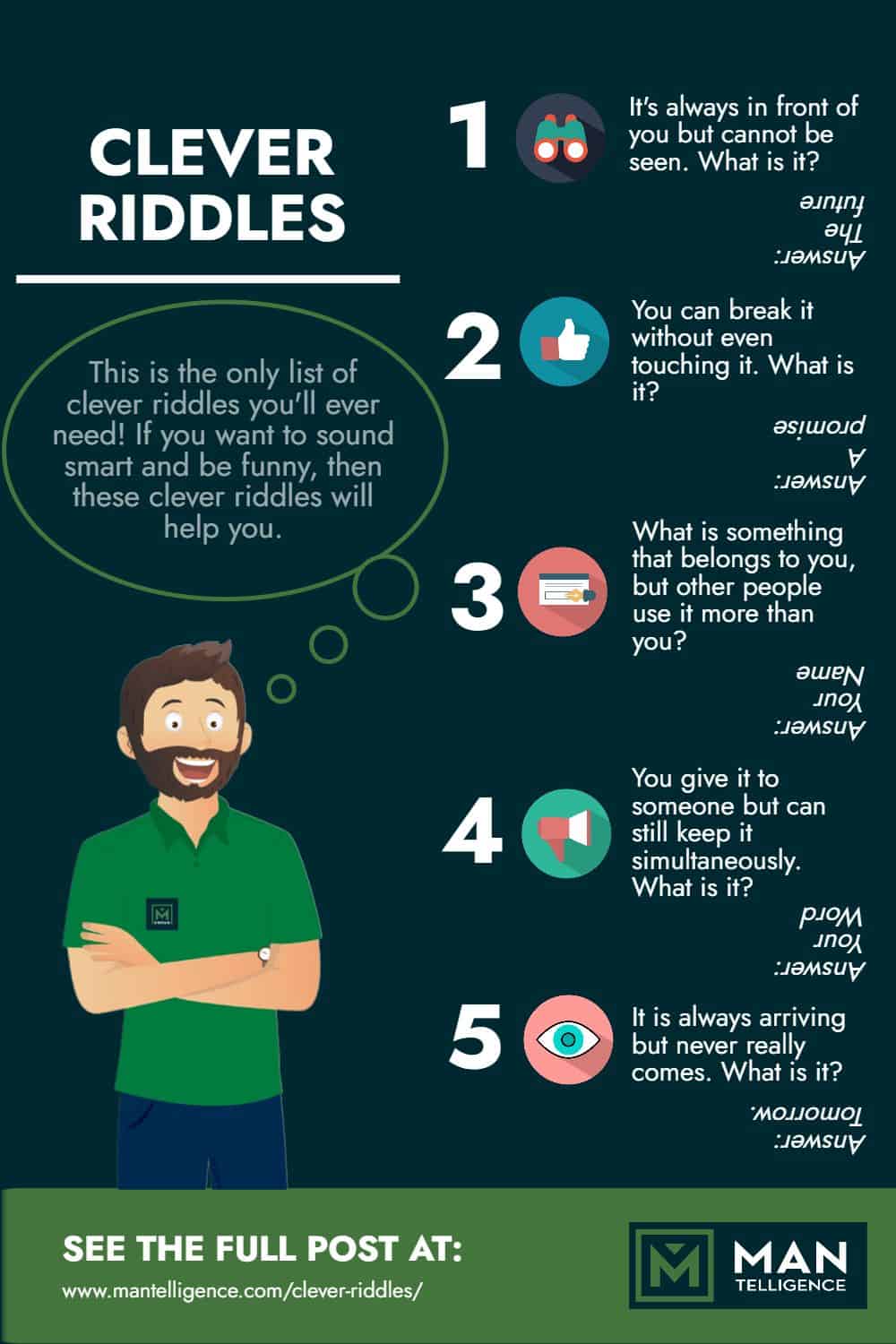
1. It’s always in front of you but cannot be seen. What is it?
2. You can break it without even touching it. What is it?

3. What is something that belongs to you, but other people use it more than you?
4. You give it to someone but can still keep it simultaneously. What is it?

5. It is always arriving but never really comes. What is it?
6. Which month has 28 days in it?
Share This Image On Your Site
6 Clever Yet Hilarious Puzzles For Adults

These are the funniest riddles with just a dash of cleverness. They’re also adult riddles guaranteed to help you laugh and have a blast solving. So, if you want a good laugh, enjoy these fun riddles!
7. What building has the most stories?
8. What has a bottom at the top?

9. What goes all around the world but stays in a corner?
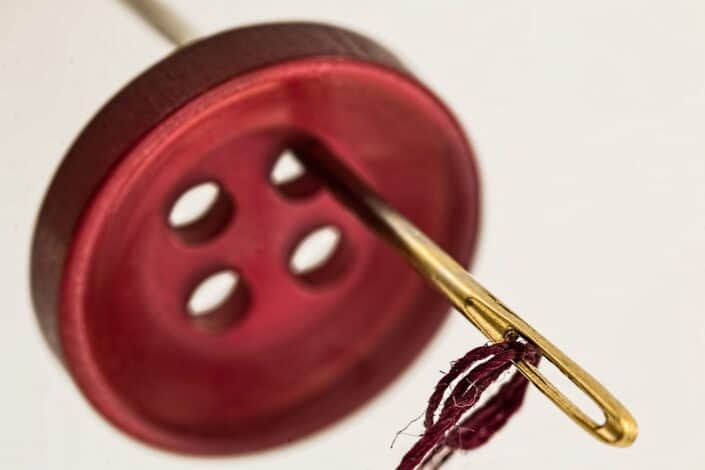
10. What has one eye but can’t see?
11. What has a head and a tail but no body?
12. What has many teeth but cannot bite?

6 Difficult But Clever Riddles to Exercise Your Brain

Clever riddles can sometimes be difficult to answer. Hard riddles may take a while to solve, but they’re great for exercising your brain. So, train your brain with some of these hard riddles! Try solving them without reading the answers: if you can manage that, you’re truly smart.
13. What can fill up a room but take up no space?
14. What is so fragile that saying its name instantly breaks it?

15. What five-letter word has one left when two letters are removed?
16. What has branches, but no fruit, trunk, or leaves?

17. This has a neck but does not have a head. What is it?
18. They come out at night without any invitation, but they mysteriously disappear during the day. What are they?

6 Easy Mystery Puzzles For Adults That They Might Find Challenging

Even the easy riddles can be challenging because of their simplicity. When you know you’re trying to solve a clever riddle, you might try to think of the most difficult answer to find – but sometimes these clever riddles are actually quite easy, so you gloss over the real answer. So, try asking some of your friends these easy riddles – see if they make that mistake.
19. Which vegetable is the king of rock and roll?
20. What did Roger Rabbit give to Jessica Rabbit when they were married?

21. What did the doctor prescribe to the sick lemon?
22. I have no legs. I will never walk but always run. What am I?

23. I don’t have a life, but I can die. What am I?
24. I have rivers but have no water. I have dense forests but no trees and animals. And, I have cities, but no people live in those cities. What am I?

6 Tricky Yet Clever “What Am I” Riddles

“What am I?” riddles are quite tricky. They ask you to figure out what they’re describing using only the smallest hints. But because of that, they can also be clever and tell you the answer in the most obtuse way. So, it’s a test whether you paid close attention to the hints provided. Don’t worry if you can’t answer these riddles – we already answered them for you.
25. I touch you from your head to your toe. The more I touch, the smaller I grow. What am I?
26. I can fly but have no wings. I can cry, but I have no eyes. Wherever I go, darkness follows me. What am I?

27. The more of these you take, the more of them you leave behind. What am I?
28. I can wave my hands at you, but can never wave goodbye. You are always cool with me, even more so when I am high! What am I?

29. If you have me, you want to tell people about me. If you share me, you don’t have me. What am I?
30. People make me, save me, change me, raise me. What am I

Downloadable and Printable List of Clever Riddles
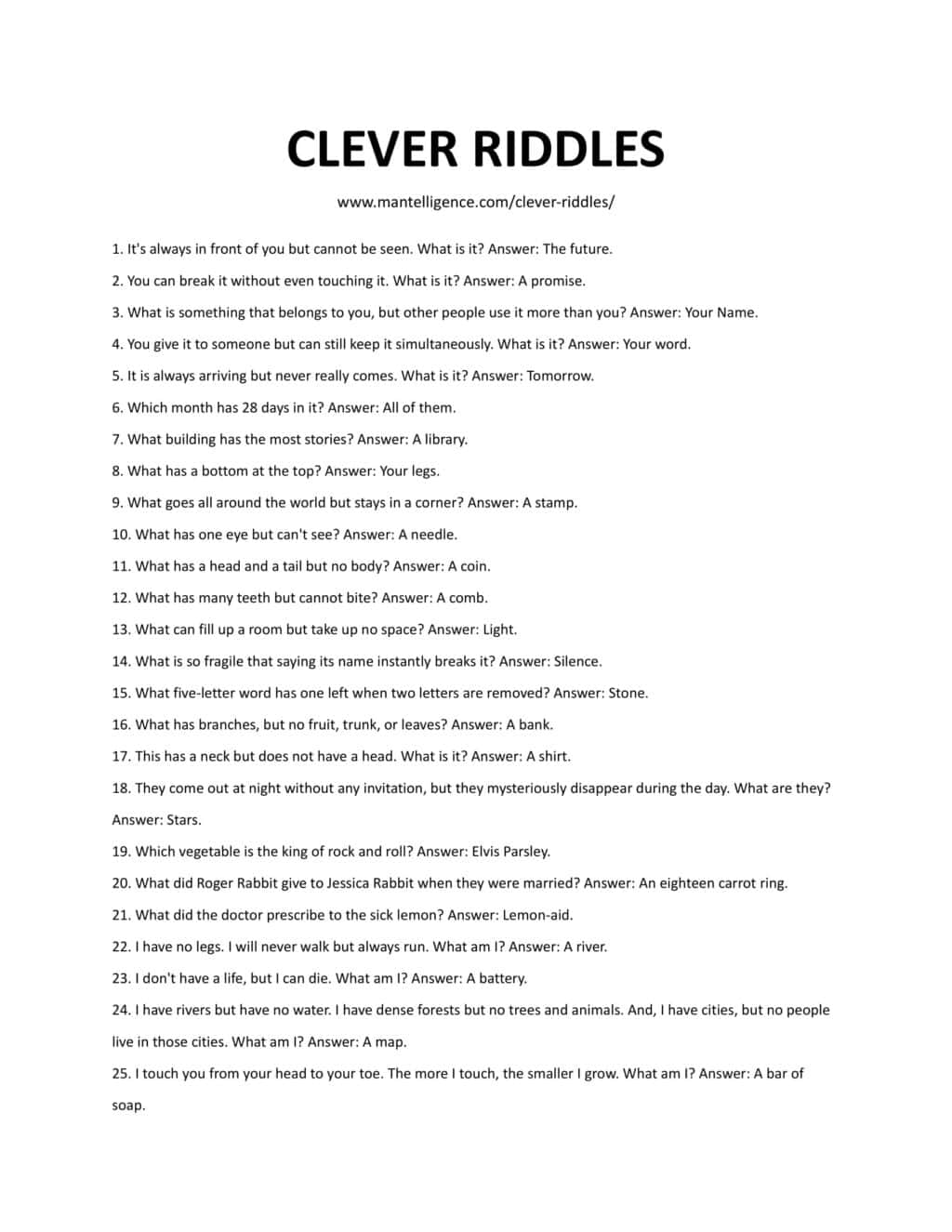
Here is a downloadable and printable jpg/pdf list of clever riddles (right-clicked the image and select Save Image As…):
7 Amazing Benefits Of Puzzles For Adults

Riddles offer plenty of benefits, especially when people try to solve them. Adults tend to benefit more than kids from riddles, having greater brainpower, creativity, and the ability to reason.
Here, I will list some of the amazing benefits riddles confer to adults – see if you managed to come across these benefits yourself after reading this article!
#1: Improved memory.

Once you’ve heard the answer to a riddle, it’s hard to forget that answer. Riddles are incredibly memorable, so when you’re asked the same riddle a second time, it becomes easy to answer because you’ve already heard it before. Even if you aren’t asked the same riddle for a long time, it becomes easy to remember again.
So, riddles tend to have a lasting impact on your memorization skills.
#2: Better Problem-Solving skills.

Naturally, the point of a riddle is to solve it. Riddles tend to make themselves more difficult through wordplay, making it harder to arrive at the correct answer. Because of that, they tend to train the problem-solving skills of the person trying to solve them.
After solving a riddle, doesn’t it become easier to solve a second one? That’s your proof.
#3: Improved Visual-Spatial reasoning.

If nothing else, riddles are imaginative. So, they also help you to imagine the situation better. Though riddles are primarily word-based, they also help people with visual learning styles imagine the riddle three-dimensionally and apply the words of the riddle to those mental images.
#4: Drastically slow the effects and reduce the risk of dementia.

Riddles are fanciful but never illogical. Reaching a riddle’s answer can be done through thinking and associating clearly. Since you have to think clearly and pay close attention to the riddle, you can reduce the effects of dementia.
As riddles contain sound, if clever logic, one can train their cognitive functions and make it harder to lose them to dementia.
#5: Provide a source of entertainment and a sense of accomplishment.

Riddles are fun and challenging to solve. Don’t you feel great accomplishment when you successfully solve a fun riddle? Riddles provide entertainment and challenge, making them incredibly rewarding to tackle.
#6: Improved mood.

Because of their entertainment value and the sense of accomplishment they give, people are often much happier after solving a riddle. If the riddle is posed as a game, they become even more effective at improving your mood.
#7: Lower stress levels.

Naturally, with an improved mood comes lower stress levels. While some riddles can be stressful trying to solve, especially if there are stakes, people often feel much more relaxed and happy after managing to solve one. So, one can lose stress by trying out riddles they consider fun and challenging.
Frequently Asked Questions

If this list of clever riddles has successfully made you feel smarter, then it’s wonderfully accomplished its purpose. However, is there anything else you need to ask about? If there is, the answers to these frequently asked questions may help.
What is the purpose of a riddle?
A riddle is an intellectual challenge. They’re asked so that they can test the answerer’s reasoning and problem-solving skills in a fun and entertaining way. Because the fun factor is directly a result of the level of challenge, riddles tend to use clever wordplay to mislead the answerer.
Do solving riddles make you smarter?
Of course, they do! Like the section above, riddles have many benefits – and being smarter is just one of those benefits. You’ll know much more through solving a riddle than without, making you smarter.
Why are riddles good for the brain?
They’re difficult and misleading, but they also have a clear way to reach the answer. Finding the right thought process despite the odds is like food for the brain – it nourishes it and helps it grow. Riddles are good for the brain because they’re challenging.
Do riddles help us grow mentally and intellectually?
The section above should tell you plenty about the good they do for our brains. Riddles are mental and intellectual challenges – and by stimulating us by making us think harder, they help our brains grow.
More Awesome Articles To Explore
We hope you enjoyed some of the best riddles we could come up with. Witty riddles are great for making puzzle games to play with friends. Want to find more games you can enjoy with others? Here are some related articles that can help.
- When the kids are away, it’s time for the adults to play. Here are some fun adult games for when the kids are out!
- Want to break the ice? Need some funny jokes? Try these fun icebreaker games!
- You don’t need to be close to anyone to play a good game! Have a good laugh and joke with some games to play over text. These are great to play with if you’ve even just a single person to text.
In Conclusion
Clever riddles are a great way to improve your critical thinking skills. There are so many kinds of riddles out there – and so many ways to have fun solving them and sharing them with others. We hope you enjoy using these fun, clever riddles on your friends!





Comments 0
No Readers' Pick yet.